
Picking a SaaS idea is easy. Picking the right niche to build in is what actually determines whether you make money.
I've built products across six different niches. Developer tools, SEO, content aggregation, social apps, productivity, AI. Some of those niches made money from day one. Others felt promising and went nowhere. The difference was never the quality of the idea. It was always the niche.
The worst part is that most of the "how to pick a SaaS niche" advice out there comes down to "follow your passion" or "solve your own problem." That's fine as a starting point. But passion doesn't pay the bills if nobody in your niche has a budget. And solving your own problem doesn't scale if you're the only person with that problem.
Here's how I actually evaluate niches now, using data instead of feelings.
The niche is more important than the idea
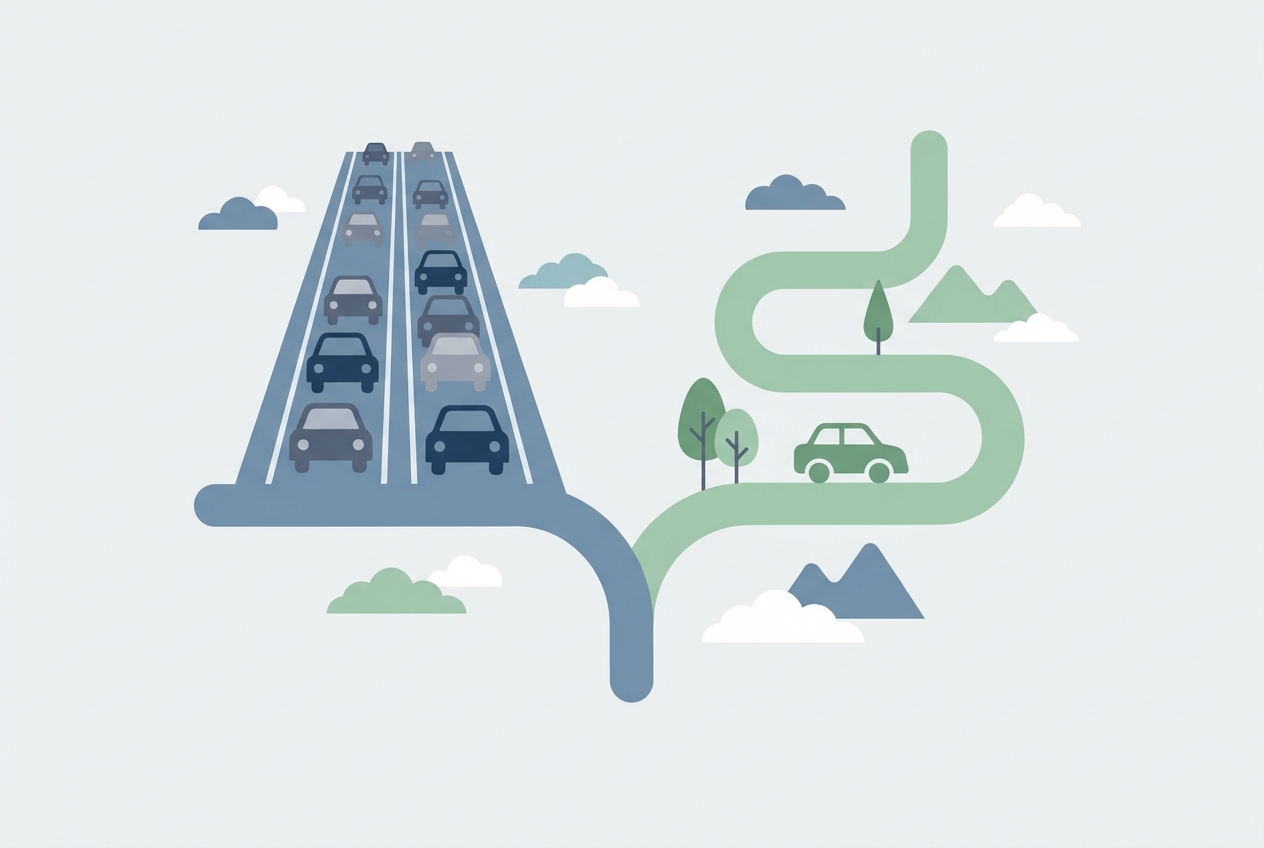
This took me four failed products to learn.
My first product was a JSON formatter. I used JSON every day, all the existing tools were ugly, and I figured I could build a better one. Classic "solve your own problem" logic. It took a weekend to build. Looked great. Worked perfectly.
The problem was the niche. "JSON formatter" gets 300,000 monthly searches, but every top result has DR 60+ and years of backlinks. I was invisible from day one. Still am.
My next product targeted a much smaller niche. Board foot calculators. I'd never calculated a board foot in my life. But the keyword had 22,000 monthly searches and a difficulty score of 8 out of 100. That tool ranked on page one in six weeks.
Same builder. Same weekend of work. Completely different outcome. The only variable was the niche.
The idea doesn't matter if the niche can't support it. A mediocre product in a good niche beats a perfect product in a dead one.
Step 1: check if people are already spending money
The fastest way to evaluate a niche is to look for existing products with paying customers. Not free tools. Not open source projects. Products where people hand over their credit card.
If nobody is paying for anything in a niche, that's not an opportunity. That's a warning. It means either the problem isn't painful enough to pay for, or the audience doesn't have budget.
Where I look:
-
Product Hunt and Uneed. Search by category. If there are products launching in your niche with upvotes and comments, that's a sign of demand. If the last relevant launch was 18 months ago, the niche might be dead.
-
G2, Capterra, AlternativeTo. These sites list products by category with reviews and pricing. If you can find 5+ products in a niche with real reviews, people are paying.
-
Indie Hackers and Twitter. Search for people sharing revenue numbers. If founders are publicly posting MRR screenshots in your niche, the economics work.
The goal isn't to find a niche with zero competition. It's to find one where money is already flowing. Competition means validation.
Step 2: measure the demand with search data
After confirming money exists in a niche, I check whether people are actively searching for solutions.
Google autocomplete is free and surprisingly useful. Type your niche keyword and see what comes up. If Google is suggesting variations, people are searching for them.
"People Also Ask" boxes are even better. These show the exact questions real people are typing. If the PAA results for your niche keyword include questions like "what's the best [tool] for [use case]" or "how to [solve problem] for [industry]," that's demand you can build for.
I don't use paid SEO tools for this step. At this stage, you're looking for signal, not precision. Ahrefs and SEMrush are great later, but for niche evaluation, free data is enough.
What I'm looking for: at least 3-5 keyword variations with organic search activity. If nobody is searching for anything related to your niche, you'll be building for an audience that doesn't exist online.
Step 3: find the gap between what exists and what people want

This is where most niche research stops. People see demand, see competitors, and either jump in or walk away. But the real insight is in the gap.
Read the 1-star and 2-star reviews of existing products in your niche. Not the 5-star ones. The complaints. That's where you find what's missing.
Common patterns I look for in negative reviews:
- "Too expensive for what it does." Pricing gap. You can undercut.
- "Works great but the UI is terrible." Design gap. You can outdesign.
- "Missing [specific feature] that I need." Feature gap. You can build exactly that.
- "Great for enterprise, overkill for small teams." Segment gap. You can build the simpler version.
Reddit is gold for this. Search for "[niche] + frustrated" or "[niche] + alternative" or "[niche] + wish." You'll find threads where people describe exactly what they want that doesn't exist yet.
The best niche isn't the one with zero competition. It's the one where existing products leave money on the table.
Step 4: evaluate the audience's ability to pay
A niche can have demand and gaps and still be a bad bet if the audience won't pay SaaS prices.
I learned this the hard way. I built a tool for students. Great engagement, lots of signups, zero conversions. Students don't have $20/month for productivity software. They barely have $20/month for food.
The question isn't "will they use it?" It's "will they pay $29/month for it?"
Niches where people reliably pay for SaaS:
-
B2B anything. Businesses have budgets. They expect to pay for tools. A $99/month tool that saves 5 hours/week is an obvious purchase for any business making real revenue.
-
Professional services. Lawyers, accountants, consultants, agencies. They bill by the hour. Time-saving tools have clear ROI they can calculate.
-
E-commerce sellers. They track profit margins obsessively. If your tool demonstrably increases revenue or reduces costs, they'll pay.
-
Developers and technical founders. They have income and they buy tools. But they're also the hardest audience to sell to because they'll try to build it themselves first.
Niches where payment is harder:
- Students and early-career professionals
- Hobbyists (unless the hobby is expensive, like photography)
- Non-profit organizations
- Consumers solving mild inconveniences
If your niche audience posts about wanting free alternatives to everything, reconsider.
Step 5: assess your distribution advantage
The last filter, and the one most people skip entirely. You can find a profitable niche with clear demand and real gaps, but if you have no way to reach the audience, you'll still fail.
Distribution matters more than the product. I know this because I've built products that were better than their competitors and lost anyway because nobody knew they existed.
Ask yourself:
-
Do you already have an audience in this niche? Even a small one (500 Twitter followers in the space, an email list of 50 people, a community presence) gives you a starting point.
-
Can you rank for keywords? If your domain has DR 0, you're not ranking for competitive keywords anytime soon. Pick niches where long-tail keywords have low difficulty scores.
-
Are there communities where this audience hangs out? Subreddits, Discord servers, Slack groups, Facebook groups. If the audience is concentrated somewhere you can reach them, distribution gets easier.
-
Can you create content about this niche? The Inkigo playbook (a tattoo app that grew to $400 MRR purely through TikTok videos about tattoo ideas, not about the app) proved that content about the topic distributes better than content about the product. Can you make content about your niche that's genuinely interesting?
I evaluate every niche on distribution before writing a single line of code. If I can't answer "how will 100 people find this in the first month?" with something specific, the niche isn't ready.
How I use data to compare niches side by side

When I'm deciding between two or three niches, I score them on five dimensions:
-
Money flowing (1-10). Are people already paying for solutions? How much? How many competitors have real revenue?
-
Search demand (1-10). Are people searching for solutions? How many keyword variations exist? What's the difficulty?
-
Gap quality (1-10). How obvious are the gaps in existing solutions? Are the complaints specific and fixable?
-
Audience budget (1-10). Can this audience afford $20-100/month? Are they B2B? Do they have purchasing authority?
-
Distribution access (1-10). Can you reach 100 people in month one? Do you have any existing presence? Are there concentrated communities?
I've built tools and databases that help me do this research faster. After spending months manually researching niches across Reddit, G2, keyword tools, and competitor sites, I started aggregating the data. That eventually became ProvenTools, which now has 99,779+ tool ideas organized by niche and 750 curated SaaS ideas with competition data. It's the research I wish I had before my first four products.
A niche that scores 7+ on at least four of these five dimensions is worth committing to. Anything below that, and you're gambling.
Real example: how I picked the "backlink tools for startups" niche

I'll walk through this with a real product I built.
I noticed that every indie founder I knew had the same problem: DR 0, no organic traffic, no idea how to get backlinks. The standard advice ("do cold outreach," "write guest posts") wasn't working for solo founders who had zero time for that.
Money flowing: I checked. Ahrefs costs $99/month. SEMrush costs $130/month. Moz costs $99/month. Clearly, people pay for SEO tools. But those are enterprise-grade. Nothing existed for indie founders specifically. Score: 8.
Search demand: "how to get backlinks for new website" and "backlinks for startups" both had search activity. Long-tail keywords had low difficulty. Score: 7.
Gap quality: Every backlink tool was either enterprise-priced or required manual outreach. Nobody offered a "done-for-you" backlink package for small sites. The gap was obvious. Score: 9.
Audience budget: Indie founders and SaaS builders. They have income. They understand ROI. A $249 one-time purchase to boost their DR is an easy decision if it works. Score: 8.
Distribution access: I already had a network of 12 web properties with real DR. I could use my own results as the case study. I had a Twitter audience of indie founders. Score: 8.
Total: 40/50. Built it. It works.
That product went from DR 9 to DR 26 in 30 days using the network I'd already built. The niche evaluation told me it would work before I wrote a line of code.
The mistake I keep seeing
Founders pick niches backwards. They start with an idea ("I'll build a better project management tool") and then try to force the niche to work. They look for evidence that supports what they already want to build.
Flip it. Start with the niche. Find where money flows, demand exists, gaps are obvious, and you have distribution. Then figure out what to build for that niche. The idea comes last, not first.
I've wasted more months building products in bad niches than I've spent building all my successful products combined. The research takes a day or two. The wrong niche costs you six months.
Do the research first.
Start here
If you want to evaluate niches with data before committing, start with the free stuff. Google autocomplete, PAA boxes, Reddit searches, G2 reviews. That gets you 80% of the way.
If you want to skip the manual work and see thousands of ideas already organized by niche with competition data and business models, check out ProvenTools. I built it because I got tired of doing this research from scratch every time.
Either way, don't pick a niche based on vibes. Use data.
Building in public. Follow me on X (@rknkhanna) for more.