
I get the same question every time I mention my product count. "How do you manage 14 products by yourself?"
The honest answer is: I don't manage all 14 equally. Some get daily attention. Some run on autopilot for months. And a few probably shouldn't exist at all, but shutting down products is harder emotionally than building them.
Running multiple products as a solo founder isn't what most startup advice tells you to do. The conventional wisdom is "focus on one thing." And that advice is right for a lot of founders. But for a specific type of builder, the portfolio approach works better. Let me explain when, why, and how.
How I ended up with 14 products (it wasn't the plan)
Nobody wakes up and decides to build 14 products. I started with one: a directory site for tool ideas. It grew. I noticed it needed backlinks to rank, so I built another site to create those backlinks. That site needed content, so I built a content tool. The content tool needed distribution, so I built a portfolio platform.
Each product solved a problem created by the previous one. That's the pattern. Not "I want to build 14 things" but "the last thing I built created a new problem, and building a tool to solve that problem also created a new product."
Some of the 14 were intentional. ProvenTools, BacklinkRocket, and VibeCoders are real products with their own customers. Others are utility sites that exist primarily to drive traffic and build domain authority for the network. They're more like infrastructure than products.
The distinction matters because managing a real product (with paying customers, support emails, and feature requests) is completely different from maintaining a static site that runs on autopilot.
The three tiers of a product portfolio
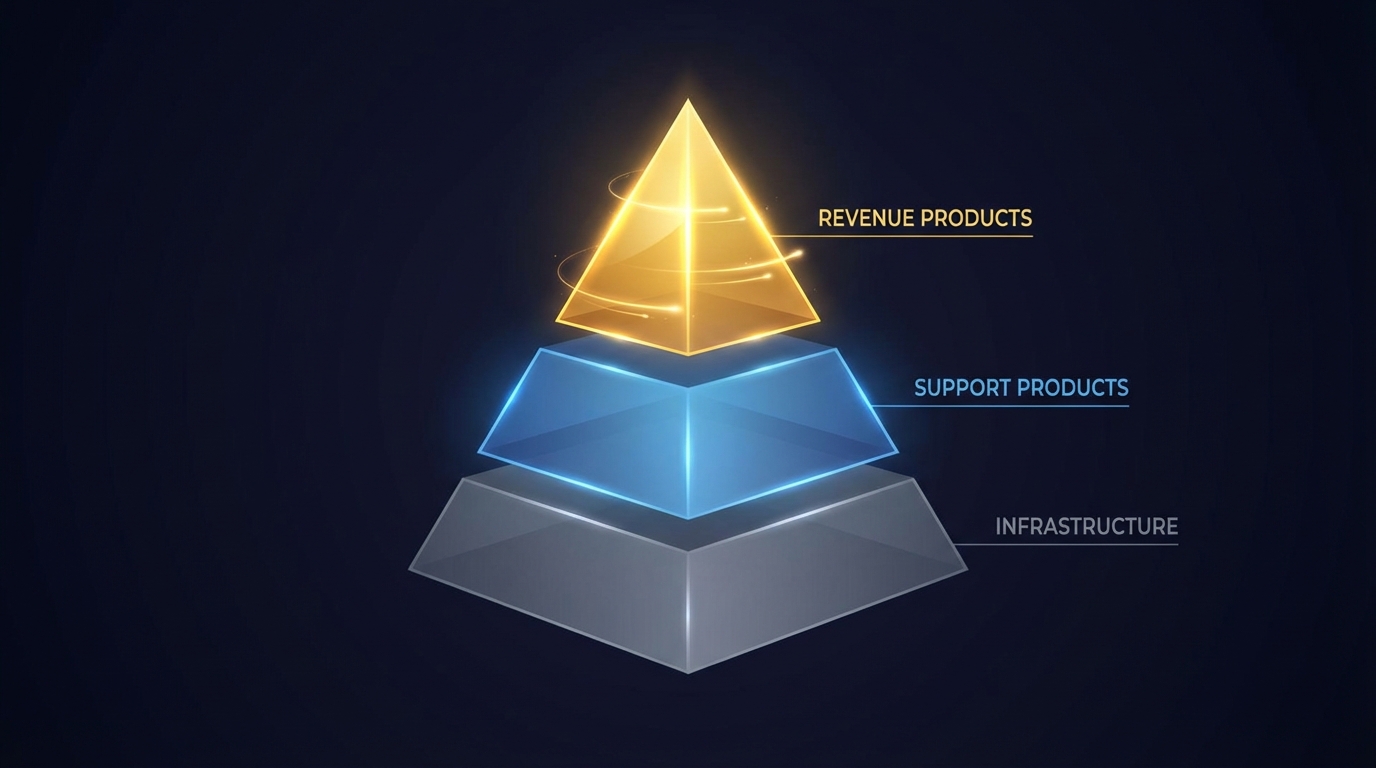
After three years of running multiple products, I've learned to categorize them into three tiers. This framework keeps me sane.
Tier 1: Revenue products.
These are the products that make money and get my active attention. Right now that's three: ProvenTools (the mega-bundle of all my idea databases), BacklinkRocket (backlink network for SaaS founders), and VibeCoders (developer portfolio platform).
Tier 1 products get daily work. Customer support, feature updates, marketing, content. When I sit down to work, these are where the time goes first.
Tier 2: Support products.
These are products that don't generate significant direct revenue but support the Tier 1 products. NicheTools (DR 39 in the July 7, 2026 Ahrefs snapshot, drives traffic and feeds ideas into ProvenTools), BuildTheIdea (idea toolkit, content source for ProvenTools), and ProvenIdeas (curated SaaS ideas, now bundled into ProvenTools).
Tier 2 products get weekly attention at most. Bug fixes, occasional content updates, and ensuring they stay online. They're valuable because they feed customers and authority into Tier 1, but they don't need constant work.
Tier 3: Infrastructure.
The remaining sites exist for SEO and backlink purposes. MicroSaaSIdeas, PMPrompts, LoremFaces, Cite.sh, Submit25, RedditGrowthDB, Liiinks, TheIndieWall. They're all part of the 12-property backlink network.
Tier 3 products get monthly attention at most. Usually just checking that they're still online and the SSL certificates haven't expired. They're lightweight sites with minimal maintenance requirements.

Why the portfolio approach works for some founders
The standard advice ("focus on one thing") assumes that your one product will get enough traction to sustain you. For many indie founders, that doesn't happen. You build one product, it makes $200/month, and you're stuck. Not enough to live on, too much to abandon.
The portfolio approach changes the math. Instead of needing one product to make $5,000/month, you need a collection of products that together make $5,000/month. The risk is diversified. If one product flatlines, the others cover it.
There's also a compounding effect that single-product founders miss. Each new product in the network creates cross-selling opportunities, backlink exchanges, and shared audience growth. My ProvenTools bundle exists because I had multiple idea databases that were more valuable together than apart. That bundling strategy wouldn't exist with a single product.
The backlink network is another example. NicheTools at DR 39 in the July 7, 2026 Ahrefs snapshot supports every other property in the network. A new site I launch today starts with 12 dofollow backlinks from day one. That advantage only exists because I built the network.
The dark side (it's real)
I'm not going to pretend this is all upside. Managing multiple products has real costs.
Context switching is exhausting. Going from a customer support email for BacklinkRocket to a bug fix on NicheTools to a marketing campaign for ProvenTools in the same day is mentally draining. You never get into deep work on any single thing.
Maintenance debt is constant. Fourteen products means fourteen codebases, fourteen hosting setups, fourteen domains to renew, fourteen sets of dependencies to update. Something is always slightly broken somewhere.
Growth suffers. The time I spend maintaining existing products is time I'm not spending on growing any single one. If I'd spent all my energy on ProvenTools alone, it would probably be further along than it is today.
Quality varies. I'm honest about this: not all 14 products are good. Some of the satellite sites are bare minimum. They serve their SEO purpose, but they're not products I'd show off in a portfolio.
If you value depth over breadth, the portfolio approach will frustrate you. If you want one product to be the absolute best in its category, focus on that one product.
How I actually manage the time
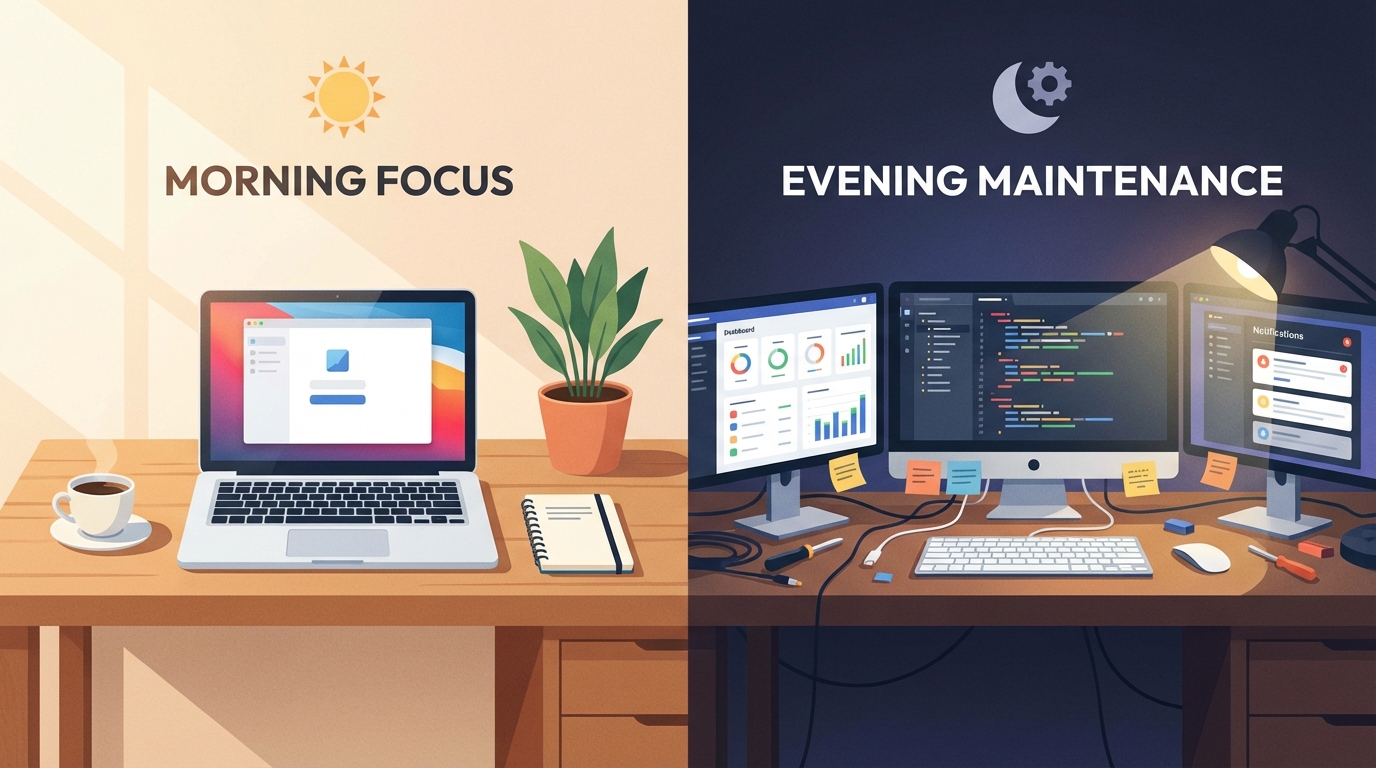
Here's the practical system I use.
Morning: Tier 1 only. The first two hours of my work day go to revenue-generating products. Customer support, feature work, marketing. Nothing else competes for this time.
Afternoon: Tier 2 and maintenance. If there's a bug on a support product or an update needed on a satellite site, it happens in the afternoon. This is also when I work on new content, SEO improvements, and cross-linking between properties.
Weekly: Network health check. Once a week, I check that all 14 sites are online, no SSL issues, no broken pages. This takes about 30 minutes with a simple monitoring setup.
Monthly: Evaluate the portfolio. Once a month, I look at the numbers. Which products are growing? Which are stagnant? Should anything be shut down? Should anything get more attention?
The key insight: most of the 14 products don't need daily attention. The satellite sites might go weeks without me touching them. The real time goes to three products, and everything else runs on minimal maintenance.
What I'd cut (if I were being ruthless)
If I had to slim down to the essentials, I'd keep five products and let the rest go static (not shut down, just frozen):
- ProvenTools (the bundle, the main revenue driver)
- BacklinkRocket (the backlink network, unique positioning)
- VibeCoders (developer portfolio, growing)
- NicheTools (DR 39 in the July 7, 2026 Ahrefs snapshot, too valuable to neglect)
- BuildTheIdea (content source, solid organic traffic)
Everything else would run on autopilot. Not shut down (the domain authority and backlinks are too valuable to lose), but not actively developed. Just... existing. Serving their purpose in the network.
The problem is emotional. Each product represents weeks or months of work. Shutting one down feels like admitting failure, even when the rational move is to focus your energy.
Lessons from building a product portfolio
1. Start with one product. Build the network later.
Don't set out to build 14 products. Build one that works, then notice what problems it creates. Those problems are your next products.
2. Every product should serve the network.
If a product doesn't drive revenue, traffic, or authority to other products in the network, it doesn't belong. Every property should earn its place.
3. Tier your products and protect your time accordingly.
Not all products deserve equal attention. The 80/20 rule applies: 20% of your products generate 80% of your value. Spend your time accordingly.
4. Bundle products when possible.
Individual products with small audiences are hard to sell. Bundles are easier because the perceived value is higher. ProvenTools bundles NicheTools, BuildTheIdea, and ProvenIdeas into one package. The bundle outsells the individual products combined.
5. Automate maintenance ruthlessly.
Uptime monitoring, SSL renewal, dependency updates. Automate everything that doesn't require human judgment. The more time you spend on maintenance, the less you spend on growth.
6. Know when to stop building and start selling.
I spent too long building products and not enough time marketing them. The 15th product is never the answer. Marketing the existing 14 is.
The portfolio vs. focus debate
I've talked to hundreds of indie founders about this. The ones who succeed with multiple products tend to share certain traits: they ship fast, they don't over-invest in any single product, and they think in terms of systems (how do all the pieces work together?) rather than individual products.
The founders who struggle with multiple products are perfectionists. They want each product to be exceptional. They can't accept "good enough" on a satellite site. They spend equal time on a $50/month product and a $2,000/month product.
Neither approach is wrong. But you need to be honest about which type of founder you are. If you can't sleep knowing that one of your 14 sites has a CSS bug on mobile, the portfolio approach will make you miserable. If you get bored working on the same product for three years, the focus approach will make you quit.
I'm the second type. I need variety. Building multiple products keeps me engaged in a way that a single product never could. The tradeoff is that none of my products are as polished as they would be with 100% of my attention.
For me, that's a tradeoff worth making. Your math might be different.

The real answer
So how do I manage 14 products by myself?
Mostly, I don't. I manage three products actively, five products occasionally, and six products passively. The network is designed so that the passive products still contribute value (backlinks, traffic, authority) without requiring my attention.
The trick isn't superhuman productivity. It's honest prioritization and the willingness to let some things be "good enough" while focusing your energy where it actually moves the needle.
If you're considering the portfolio approach, start small. One product, then two. See how it feels. If the second product naturally feeds into the first, you're on the right track. If it just divides your attention without adding compounding value, stick with one.
The number of products isn't what matters. What matters is whether they work together as a system or compete against each other for your time.
I'm building in public as a solo founder running 14+ web properties. Follow me on X/Twitter for daily updates on what's working, what's failing, and what I'm learning along the way.